
Payday loan rules depend on the state where you live. Your state’s laws and regulations determine how much you can borrow, how much a lender can charge, and how long you have to repay.
In most states where we offer payday loans, you repay the loan in one payment around your next payday. Some states require longer repayment terms, while others do not allow payday loans at all.
Which Kind of State Do You Live In?
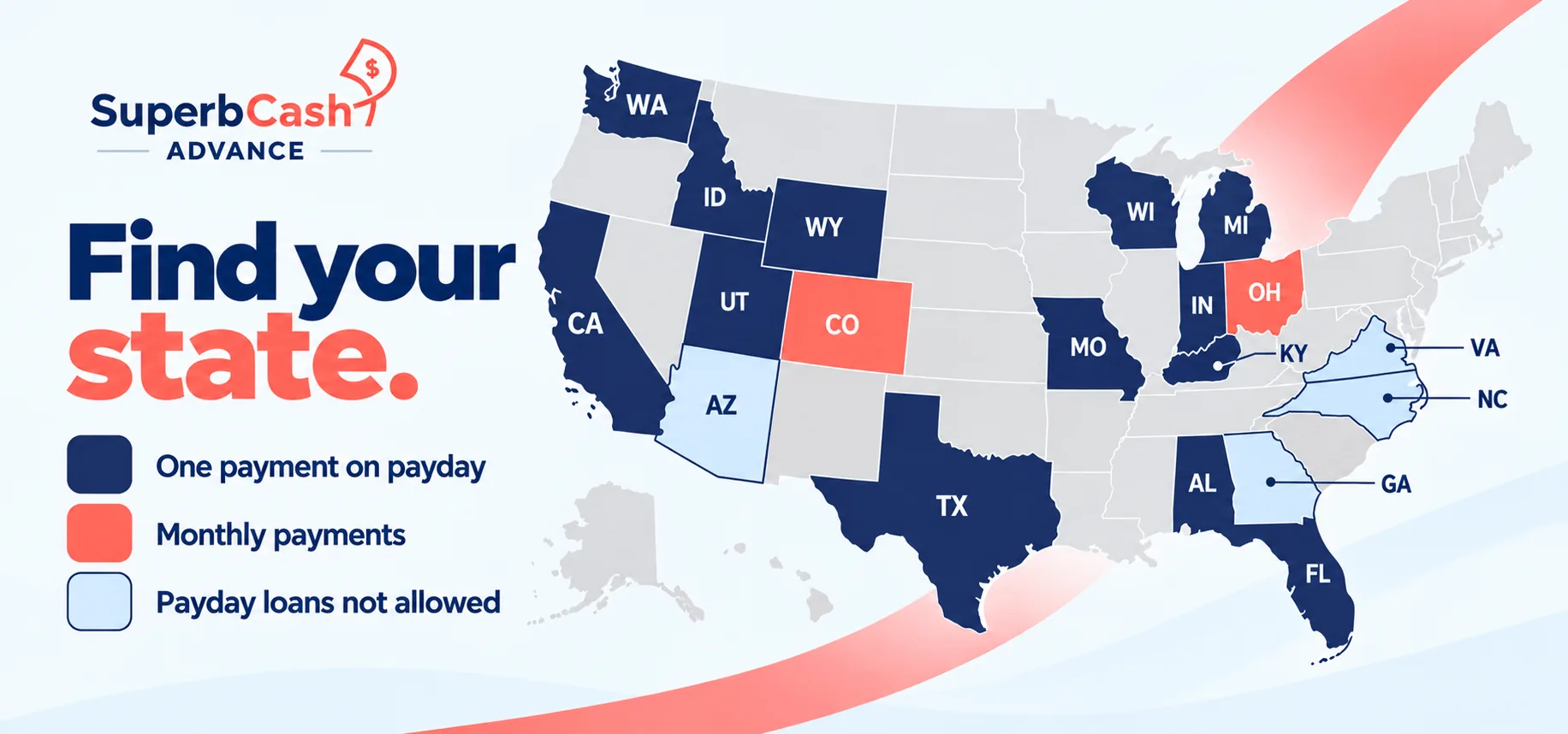
- One payment on payday: Alabama, California, Florida, Texas, and most other states where we lend
- Monthly payments: Colorado and Ohio, where you repay over several months
- Payday loans not allowed: Arizona, Georgia, North Carolina, and Virginia, where we offer installment loans instead
Key Takeaways
- Your state sets the limit and the fee. Where payday loans are allowed, most states where we lend cap how much you can borrow, and many also cap the fee.
- We lend up to $500. Even if your state allows more, $500 is the most you can borrow from us on a payday loan, and where the law sets a lower limit, that limit applies.
- Four states use installment loans instead. Arizona, Georgia, North Carolina, and Virginia do not allow payday loans, so we offer installment loans there.
- Look at the cost in dollars. Before you sign, check the fee and the total you will repay.
Payday Loan Rules in States With One Payment on Payday
In states where the loan is repaid in one payment, legal borrowing limits vary widely. For example, California allows a check of up to $300, while Wisconsin allows loans up to $1,500. Texas and Utah do not set a statewide maximum.
Even where state law allows more, Superb Cash Advance lends up to $500. If you need a higher amount and your state allows it, another licensed lender may be able to offer more.
| State | Most You Can Borrow | What the Law Lets a Lender Charge |
|---|---|---|
| Alabama | $500 | 17.5% of the amount advanced |
| California | A $300 check, about $255 in cash | Up to 15% of the check |
| Florida | $500 | 10% of the amount plus a $5 verification fee |
| Idaho | $1,000. We lend up to $500. | No state cap |
| Indiana | $825. We lend up to $500. | 15% on the first $250, 13% on the next $150, 10% on the rest |
| Kentucky | $600 at one time. We lend up to $500. | Up to 15% of the check. A $3 state database fee may be added. |
| Michigan | $600. We lend up to $500. | 15% on the first $100, then 1% less on each $100, down to 11% |
| Missouri | $500 | No cap on one loan’s fee. Interest and fees on a loan and its renewals are capped at 75% of the amount borrowed. |
| Texas | No state limit. We lend up to $500. | No state cap. Texas regulates these lenders as Credit Access Businesses |
| Utah | No state limit. We lend up to $500. | No state cap |
| Washington | $700. We lend up to $500. | 15% on the first $500, 10% on the rest |
| Wisconsin | $1,500. We lend up to $500. | No state cap until the loan is due |
| Wyoming | $400 at one time. We lend up to $400. | The greater of $30 or 20% of the balance a month |
Some states also cap a loan at a share of your income: 25% in Idaho, 20% in Indiana, 30% in Washington, and 35% in Wisconsin. Open your state’s page for repayment time, renewals, and returned-payment fees, or apply online.
Payday Loan Rules in Colorado and Ohio, With Monthly Payments
In Colorado and Ohio, you repay a payday loan in monthly payments over several months, and Colorado law requires at least six months. Because the loan runs for months, both states cap the cost as a yearly rate, and Ohio also limits the fees on top of it.
| State | Most You Can Borrow | What the Law Lets a Lender Charge |
|---|---|---|
| Colorado | $500 | 36% a year, all fees included |
| Ohio | $1,000. We lend up to $500. | 28% a year, plus a monthly fee of the lesser of 10% or $30, and a one-time 2% charge on loans of $500 or more |
A yearly rate and a flat fee are measured differently, so these limits cannot be compared with the one-payment states.
Payday Loans Not Allowed in Arizona, Georgia, North Carolina, and Virginia
Because Arizona, Georgia, North Carolina, and Virginia do not allow payday loans, Superb Cash Advance offers installment loans there, which you repay in set payments over a longer term.
What Does a Payday Loan Fee Cost in Dollars?
Many state laws cap payday loan fees at $10 to $30 for every $100 borrowed. The Consumer Financial Protection Bureau says $15 per $100 is common, which can equal an APR of nearly 400% on a two-week loan.
Examples of Payday Loan Costs
- California: you write a check for $300 and get about $255, so the fee is $45.
- Florida: on a $500 loan, the maximum fee is $55, so you would repay $555 on the due date.
- Texas: there is no state fee cap, so at about $20 per $100, a $300 loan costs about $60 and you repay about $360.
Costs vary by state. In states with fewer limits on payday loan fees, such as Texas and Idaho, borrowing can cost more.
Before you sign, your loan agreement will show the fee, APR, and total amount you must repay. Check the total cost against your budget and borrow only what you can afford to repay. You can also see how a cash advance compares with cheaper options before you apply.
Frequently Asked Questions
Can I Have More Than One Payday Loan at a Time?
Yes, in some states. Your state may limit how many payday loans you can have open at once, and some states track every open loan in a statewide database so a lender can see them.
For example, Florida allows only one open payday loan at a time. Michigan and Indiana allow up to two, but never two from the same lender, and California does not allow a lender to give you another payday loan while you still have one open with that same lender.
Taking more than one payday loan can make repayment harder and raise the risk of extra fees or debt, so borrow only what you can repay from your next paycheck.
Can You Go to Jail for Not Paying a Payday Loan?
No. You cannot be arrested simply because you did not repay a payday loan, and in most states where we lend, the law does not let a lender press criminal charges over it. A check written on an account that was already closed can be treated differently.
A lender or debt collector may sue you to collect the debt. If that happens, answer the court papers and go to any hearing, because ignoring a court order can lead to a warrant in some states. Wages can be garnished only if the lender wins a court judgment, and Texas does not allow wages to be garnished for this kind of debt.
Can I Apply for a Payday Loan Online in My State?
Yes, you can apply online for a payday loan or installment loan from your phone or computer in each state where we provide loans, and how it works shows each step.
In some states the law requires the money to be paid in cash in person, so you collect it at the store.
